What Is a Near Miss?
A near miss is an unplanned event that could have resulted in injury, illness, or damage but didn’t. You might also hear it called a close call or near hit. The defining feature is simple: something happened, but nobody got hurt.
These events occur more often than most organizations realize. Here are a few examples:
| Near Miss | What Could Have Happened |
|---|---|
| A fall from a ladder caught by a coworker | Broken bones, head trauma |
| Heavy equipment narrowly misses a worker | Crushing injury, fatality |
| Hazardous materials container left unattended | Chemical exposure, burns |
| A long heavy object swings during transport | Struck-by injury |
| Unsecured load shifts on a forklift | Workers struck or pinned |
In each case, luck or quick reflexes prevented someone from getting injured. The circumstances were dangerous. The outcome just happened to be okay.
That “miss” is your opportunity. Every near miss incident reveals a hazard in your workplace before it causes real harm. The question is whether you’re capturing these warnings or letting them disappear.
Keep reading to learn more or get the free template here.
Why Near Misses Matter: The Safety Pyramid
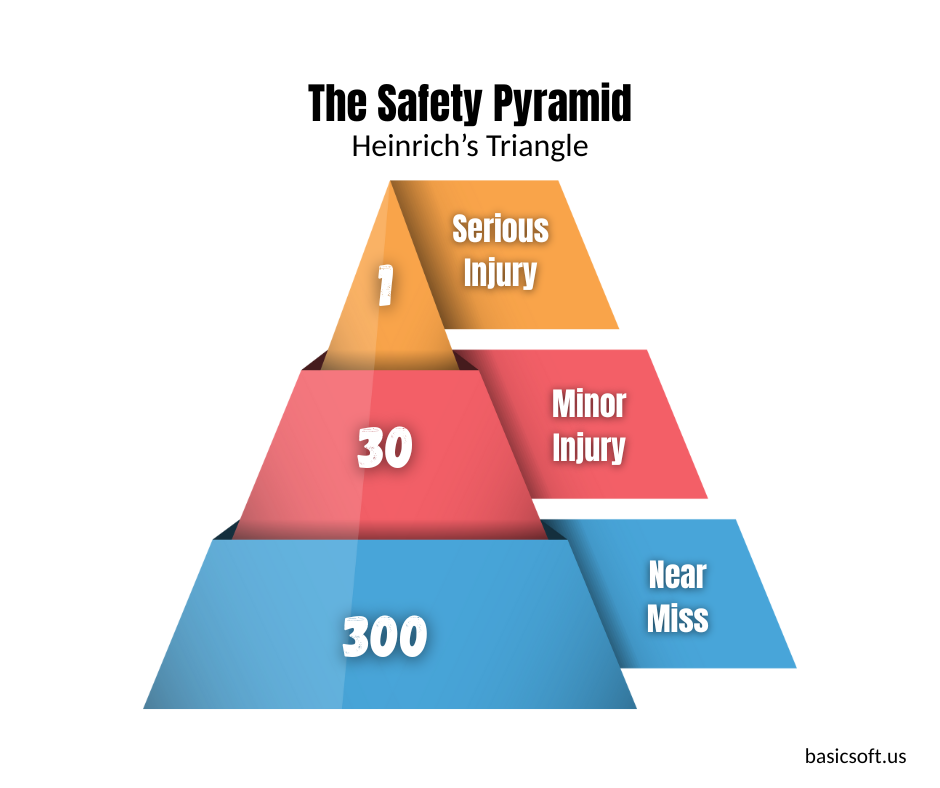
Here’s a number that should get your attention. According to safety research popularized by the National Safety Council, for every serious injury in a workplace, there are roughly 300 near misses lurking in the background.
Think of it like an iceberg. The injuries you see are just the tip. Below the surface sits a massive foundation of close calls, minor incidents, and unsafe conditions that never made it into a report.
The Free Warning System
Near misses are essentially free lessons. The same hazards that cause close calls today will eventually cause accidents tomorrow. The universe gave you a preview. The question is whether you’re paying attention.
Every unreported near miss is a missed chance to prevent recurrence. That hazard doesn’t fix itself just because nobody got hurt this time.
Leading vs. Lagging
Injuries are lagging indicators. By the time you’re counting them, the harm already happened. You’re keeping score on a game you already lost.
Near misses are leading indicators. They tell you what might happen next if you don’t act. This is the proactive approach to reduce risks before someone actually gets injured.
Building risk awareness around near misses shifts your entire safety culture. Instead of celebrating months without recordable incidents, you start celebrating catches. That’s continuous improvement in action. That’s a positive safety culture taking root.
Building a Near Miss Reporting System
A near miss reporting system only works if people actually use it. Groundbreaking insight, right? But you’d be surprised how many organizations build elaborate reporting processes that nobody touches because they’re too complicated, too slow, or too likely to get someone in trouble.
Keep It Simple
Your reporting system needs to be accessible to every employee and worker who might witness a close call. That means:
- Available on electronic devices for field use
- Completable in under two minutes (seriously, time it)
- Paper backup for workers without device access
- No login gymnastics or password archaeology required
A digital solution gives you searchable, trackable, analyzable data. Paper forms work in a pinch, but they tend to disappear into filing cabinets where insights go to die.
Design the Flow
Think through your reporting process before you launch it.
| Decision | Recommendation |
|---|---|
| Who can submit | Anyone (no gatekeeping) |
| Where reports go | Safety team and/or supervisor |
| Anonymous option | Yes, at least initially |
| Timeline | Same day when possible |
You’ll also want categories for the types of workplace hazards you’re tracking. Slips and trips, struck-by, caught-in, falls, vehicle-related. Location matters too, especially if you have a construction site, warehouse, and office all generating different risks.
The goal is a form that captures useful information without feeling like a tax return. If your reporting process requires fifteen dropdown menus and a blood sample, people will suddenly have very poor memories about what they witnessed.
Make reporting the path of least resistance, and the reports will follow.
What to Capture in a Near Miss Report
Your near miss form needs to collect enough detailed information for meaningful analysis without turning into an interrogation. Strike the balance wrong and you’ll either get useless one-liners or nothing at all.
The Essentials
| Field | Why It Matters |
|---|---|
| Date and time | Pattern identification |
| Location | Hazard hotspot mapping |
| Reporter (optional) | Follow-up capability |
| People involved | Exposure assessment |
| Description | Understanding what happened |
| Potential hazard type | Categorization |
Incident Details
The description field does the heavy lifting. You want enough context to understand the circumstances without requiring a novel. Capture:
- What was the unplanned event
- What potential hazard was involved (heavy equipment, hazardous materials, tools, environment)
- What prevented injury (luck, awareness, existing controls)
- Who else was nearby during the close call
If someone writes “almost got hit by thing,” that’s not going to fuel a useful investigation. Coach people to include the what, where, and how.
Action Fields
Every near miss incident should prompt thinking about next steps.
- Immediate actions taken at the scene
- Recommended corrective actions
- Obvious root causes if apparent
- Hazard control suggestions
- Risk assessment of what could have happened
This section turns a report into a starting point for prevention. The form captures the close call. The action fields capture the path forward. Both matter if you want your reporting to actually reduce risks instead of just documenting them.
Getting Employees to Report Near Misses
You can build the most elegant near miss reporting system in the world. If employees are afraid to use it, you’ve built a very expensive suggestion box that collects dust.
Kill the Fear
Fear of blame is the number one killer of near miss reporting. Workers who think they’ll get in trouble will suddenly develop amnesia about that close call they witnessed. Every time.
Build psychological safety first:
- Offer anonymous reporting options
- No punishment for honest reports
- Make the form simple (complicated equals ignored)
- Ensure mobile access on electronic devices
Accurate reporting requires trust. If your safety culture punishes the messenger, messages stop coming.
Build the Habit
Once fear is off the table, you need workers to actually think about reporting when something happens.
| Action | Why It Works |
|---|---|
| Educate employees on what qualifies | People report more when they understand what counts |
| Training on using the system | Removes technical excuses |
| Share real examples | Makes it concrete |
| Recognize reporting publicly | Shows it matters |
| Act visibly on reports | Proves someone is listening |
Share success stories where near miss reports prevented injuries. When employees see that their reporting actually fixed a hazard, they’re more likely to do it again.
Leaders set the tone here. When supervisors respond to every report and celebrate catches instead of just clean records, a positive safety culture takes root. Organizations that get this right turn near miss reporting from a chore into a reflex.
Near Miss Report Template
Why start from scratch? We’ve put together a downloadable near miss report template that covers everything discussed above. Grab it here and start capturing close calls today.
The template includes:
- Basic incident information fields
- Event description section
- Hazard type and risk assessment
- Root cause checkboxes
- Corrective actions tracking
- Review and follow-up section
Print it for clipboard use or deploy it digitally. Your call.
Start Capturing What Almost Happened
Every near miss reported is an accident prevented. Every close call documented is a serious injury avoided. A working near miss reporting system transforms workplace safety from reactive paperwork into proactive prevention.
The hazards in your workplace are already there. The question is whether you’ll find them before they find your workers.
Want to go digital? EHSpro includes built-in near miss tracking alongside full incident management, so your reports feed directly into investigations, corrective actions, and trend analysis. One system, no paper cuts.
*Near miss reporting is not included in the free version